
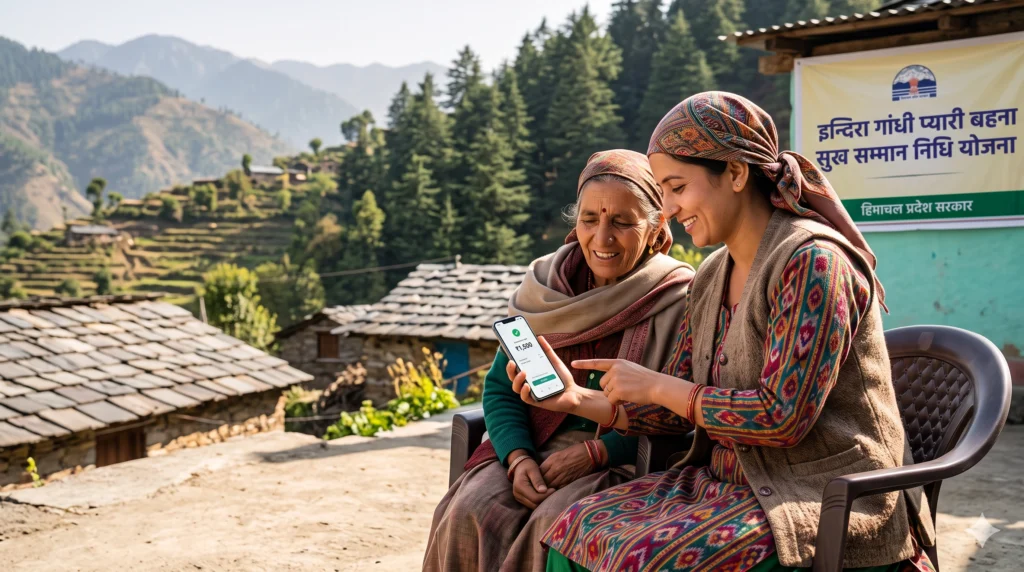
The Indira Gandhi Pyari Behna Sukh-Samman Nidhi Yojana is a targeted monthly social assistance grant initiated by the Government of Himachal Pradesh. Administered through the Department of Social Justice and Empowerment, it provides a direct cash transfer of ₹1,500 per month (₹18,000 annually) to eligible women aged between 18 and 59 years. The scheme enforces rigorous family-level exclusions, specifically barring households with government employees, pensioners, or income tax payees.
Status: Operative statewide under notified rules. Applications are verified and processed through physical submission at local Gram Panchayats, Anganwadi Centres, and Tehsil Welfare Offices (TWO).
Scheme Snapshot: Key Parameters
| Parameter | Verified Detail |
|---|---|
| Administering Department | Department of Social Justice and Empowerment / Directorate of Women & Child Development, HP |
| Scheme Nature | Direct Benefit Transfer (DBT) Cash Grant (Not a loan, pension top-up, or insurance) |
| Financial Benefit | ₹1,500 per month (disbursed directly via DBT into beneficiary bank accounts) |
| Target Beneficiary | Bonafide female residents of Himachal Pradesh aged 18 to 59 years |
| Primary Disqualification | Any family member serving in/retired from Government, PSUs, Autonomous Bodies, or paying Income Tax |
| Application Mode | Offline verification via physical application submitted to Anganwadi Workers or Tehsil Welfare Officers |
Eligibility Criteria: Who Qualifies?
To be considered for the grant, an applicant must satisfy all demographic and domicile thresholds on the date of application:
- Himachali Domicile: The applicant must be a certified Bonafide Resident of Himachal Pradesh.
- Age Window: Must have completed 18 years of age and must not have exceeded 59 years. (Upon turning 60, beneficiaries transition toward standard Old Age Pension programs under the State Social Security rules).
- Independent Bank Account: Must maintain an active personal savings bank account or postal account with Direct Benefit Transfer (DBT) and Aadhaar seeding enabled. Joint accounts with excluded individuals are not accepted.
Mandatory Exclusions: Who Cannot Apply?
The scheme contains strict, statutory disqualification filters designed to target public financial resources away from households with assured institutional income. An applicant is strictly ineligible if the applicant or any member of her immediate family/household falls under any of the categories below:
- Regular or Contractual Government Employees: Employees of Central Government, State Government, Board, Corporation, Autonomous Body, or Public Sector Undertakings (PSUs).
- Part-Time & Honorarium Workers: Daily wagers, outsourced personnel, and contractual appointees in state or central offices.
- Institutional Pensioners: Anyone drawing pensionary benefits (Service Pension, Military Pension, EPS, or Family Pension) from Central, State, or Autonomous entities.
- Existing Social Security Pensioners: Women who already draw ₹1,000, ₹1,150, or any equivalent monthly benefit under social security welfare schemes (unless transitioning under specific enhancement clauses notified by the Directorate).
- Income Tax Payers: Households where any family member files an Income Tax Return or pays income tax.
- Specific Scheme Functionaries: Anganwadi Workers, Anganwadi Helpers, ASHA Workers, and Mid-Day Meal workers receiving statutory government honoraria (unless separate specific cabinet allowances are issued).
Document Checklist: Requirements & Verification Purpose
Incomplete dossiers lead to immediate rejection during scrutiny at the Tehsil Welfare Office. Ensure each document is self-attested and clearly legible:
| Required Document | Statutory Verification Purpose |
|---|---|
| Bonafide Himachali Certificate | Confirms permanent resident status and legal domicile in Himachal Pradesh. |
| Age Proof (Matric Certificate / Birth Certificate) | Verifies that the applicant satisfies the 18 to 59 age window on the filing date. |
| Aadhaar Card Copy | Serves as biometric demographic identity verification and linkage for DBT. |
| Parivar Register Copy (Panchayat Parivar Copy) | Establishes complete family composition to cross-check household exclusions. |
| Ration Card Copy | Corroborates residential unit categorization and household members. |
| Bank Passbook Copy (First Page) | Confirms Account Number, IFSC code, and active single-holder status. |
| Self-Declaration / Non-Employment Affidavit | Formal undertaking confirming no family member works in government or pays income tax. |
Step-by-Step Application Procedure
Do not rely on private websites, unverified third-party APKs, or agents charging unofficial fees. The legitimate application workflow is completely paper-based or routed through sanctioned civic access points:
Step 1: Obtain the Prescribed Application Form
Collect the official application form free of cost from your local Anganwadi Worker, Gram Panchayat Secretary, or the office of the Tehsil Welfare Officer (TWO). Official downloadable copies are periodically released via the Himachal Pradesh Social Justice and Empowerment portal.
Step 2: Complete the Family & Bank Details
Fill in all demographic details exactly as they appear on your Bonafide Certificate and Parivar Register. Enter bank credentials carefully, ensuring that your account is seeded with Aadhaar and designated for DBT credit.
Step 3: Submit to Local Verification Authority
Submit the completed form along with attached photocopies to your designated Anganwadi Worker or submit directly at the Tehsil Welfare Office. Request a dated physical receipt or counter-signed acknowledgment slip for your records.
Step 4: Scrutiny and District Approval
The TWO consolidates submitted applications, checks the Parivar Register for non-employment compliance, and submits qualified candidate lists to the District Welfare Officer (DWO). Once sanctioned, the monthly grant is credited directly through e-Kuber/DBT.
Hypothetical Case Study: Testing Real-World Eligibility
To understand how household exclusions function in practice, consider the following hypothetical scenarios from rural Mandi district:
Case A: Sunita (Eligible)
Sunita is 32 years old, residing in a rural gram panchayat. Her husband is an agricultural worker without a fixed government salary. Neither Sunita, her husband, nor dependent household members pay income tax or draw any government pension. She holds a valid Bonafide certificate and a separate bank account.
Outcome: Meets all notified criteria. Eligible for ₹1,500 monthly DBT.
Case B: Meena (Disqualified)
Meena is 24 years old and unmarried. She does not have personal income. However, her father is an employee in the state Jal Shakti Department and listed in the shared Panchayat Parivar Register.
Outcome: Disqualified. The scheme bars anyone whose immediate family includes a regular or contractual state/central government employee.
Common Scrutiny Hurdles and Rejection Grounds
Scrutiny teams evaluate submissions against departmental guidelines. Common grounds for rejection include:
- Panchayat Register Mismatches: Failure to account for household members who hold government jobs or draw pensions.
- Dormant Bank Accounts: Accounts without active National Automated Clearing House (NACH) / DBT functionality fail automated disbursement runs.
- Existing Pension Overlap: Women currently enrolled under other state social assistance programs without opting for the approved scheme conversion pathway.
- Incomplete Affidavits: Submitting application forms lacking the mandatory signed self-declaration affirming non-income-tax status.
Grievance Recourse: If an application is rejected erroneously, applicants can file an appeal with the Sub-Divisional Magistrate (SDM) or visit the Tehsil Welfare Office within 30 days of the declaration of sanitized scrutiny lists.
Frequently Asked Questions
Can more than one eligible woman in the same family apply?
Subject to final scrutiny of the family register, multiple adult female members (e.g., mother and unmarried adult daughter) may be eligible provided the entire household passes the negative exclusion list (no government employees, no pensioners, no income tax payees).
Is there an online portal to submit the application form?
Initial application intake is predominantly physical via Anganwadi centres and Tehsil Welfare Offices to facilitate document cross-verification with Panchayat registers. Citizens should verify through local authorities before paying private web kiosks for unverified submission links.
What happens when a beneficiary turns 60 years of age?
Upon completing 59 years, eligibility under this specific scheme terminates. The beneficiary transitions to the standard Himachal Pradesh Old Age Pension scheme under social security rules, which provides benefits to citizens aged 60 and above.
Are outsourced or daily-wage workers considered government employees?
Under the official negative list, contractual, outsourced, and daily-wage appointees deployed in government departments, boards, and corporations are generally classified under the exclusion clause, rendering the household ineligible.
Notice: HimState.in is an independent civic information platform. We do not process government applications, collect personal identity documents, or act on behalf of the state administration. For direct inquiries, visit your local Tehsil Welfare Office or nearest Anganwadi Centre.