
HIMSTATE · DISTRICT REFERENCE
Kangra District, Himachal Pradesh
Explore a district shaped by the Dhauladhar, the Beas basin, historic hill states and the everyday lives of its people. Start with the essentials, then follow subjects and places into detailed guides.
Kangra district: an introduction
Kangra is a district of Himachal Pradesh in northern India, with its administrative headquarters at Dharamshala. Its identity includes Kangra town and fort, the tea-growing landscape around Palampur, the Dharamshala–McLeod Ganj area, pilgrimage centres and the Pong reservoir.
The district is a place to live, work and study as well as visit. This reference hub brings its geography, history, people, institutions and visitor experiences together, while leaving room for dedicated town profiles, historical entries and practical guides.
| Name | What it means |
|---|---|
| Kangra district | The administrative territory covered by this hub. |
| Kangra town | A particular town within the district, associated with Kangra Fort and the Bajreshwari Devi shrine. |
| Kangra Valley | A geographical and cultural expression, not a substitute for the district’s precise administrative boundaries. |
On this page: Key facts · Geography · History · People & culture · Towns & regions · Temples & heritage · Economy · Nature · Travel · Education & health · Administration · Notable people · Topic directory · FAQs
Kangra at a glance
| Fact | Reference |
|---|---|
| Headquarters | Dharamshala |
| Area | 5,739 sq km — Census 2011 district reference |
| Population | 15,10,075 — Census 2011 |
| Literacy rate | 85.67% — Census 2011, population aged seven and above |
| Sex ratio | 1,012 females per 1,000 males — Census 2011 |
| Population density | 263 people per sq km — Census 2011 |
These Census figures describe 2011, not the current population. Kangra was Himachal Pradesh’s most populous district in that Census. Present-day town limits and administrative units should be checked separately before comparing local statistics.
Geography: from the valley to the Dhauladhar
A district with contrasting landscapes
Kangra is often pictured through the steep Dhauladhar skyline, but its landscape also includes settled valleys, cultivated slopes and lower hills. A district-wide description should therefore distinguish the mountain edge from places nearer the plains and the reservoir. One altitude or temperature cannot represent every part of Kangra.
Water, settlement and the Beas basin
The Beas is central to the district’s river landscape. The Pong reservoir, also called Maharana Pratap Sagar, is an artificial water body on this river. Its shores create a different environment from the streams and hills around Dharamshala and Palampur.
For a wider introduction, read HimState’s overview of Himachal Pradesh’s rivers.
Geography and rivers of Kangra
[LINK NEEDED: kangra-geography-rivers]
Climate and seasonal differences
Use the destination, elevation and season when assessing weather. A forecast for Dharamshala is not a forecast for a high mountain pass. Monsoon rainfall, winter conditions and local road reports matter more to a particular journey than a single district-wide “best weather” label.
Kangra weather and seasons
[LINK NEEDED: kangra-weather-best-time-to-visit]
History: Trigarta, hill states and modern Kangra
Kangra’s historical identity is associated with Trigarta, Nagarkot and the Katoch rulers. Epic traditions belong to its cultural memory, but they do not by themselves establish a monument’s construction date or an unbroken modern boundary.
| Period / date | Historical context |
|---|---|
| 1620 | Kangra Fort came under Mughal control during Jahangir’s reign. |
| Late eighteenth century | Sansar Chand’s rule became a major chapter in Kangra’s political and artistic history. |
| 1809 | Ranjit Singh’s intervention against the Gurkhas brought the fort under Sikh control. |
| 1846 | British control followed the First Anglo-Sikh War. |
| 4 April 1905 | The Kangra earthquake caused severe destruction, including damage to the fort. |
| 1966 | Punjab’s reorganisation transferred Kangra to Himachal Pradesh. |
| 1 September 1972 | The then Kangra district was reorganised into Kangra, Hamirpur and Una districts. |
The modern district must be distinguished from the territories described in older princely-state and colonial accounts. A historical reference to Kangra can cover a different area from today’s district. Read territorial changes alongside the date of the record.
History of Kangra
[LINK NEEDED: history-of-kangra]
The 1905 Kangra earthquake
[LINK NEEDED: kangra-earthquake-1905]
Kangra’s changing district boundaries
[LINK NEEDED: kangra-district-formation-boundaries]
People, language and culture
Kangri and a diverse social landscape
Kangri is central to the district’s linguistic identity. Language use also reflects Gaddi communities, Tibetan settlements and connections with neighbouring regions. A regional language, an administrative language and a person’s mother tongue are different categories; they should not be treated as interchangeable.
The district’s cultural life includes farming households, artisans, traders, students, service workers and people who move between villages and towns. No single costume, occupation or festival represents every resident.
Kangri language and oral traditions
[LINK NEEDED: kangri-language]
Gaddi communities in Kangra
[LINK NEEDED: gaddi-communities-kangra]
Tibetan cultural life around Dharamshala
Dharamshala’s modern history includes the Tibetan community and institutions established in exile. McLeod Ganj is part of this wider setting. Monasteries, learning, artistic practice and community life deserve attention beyond their appearance on a sightseeing list.
Tibetan culture in Dharamshala
[LINK NEEDED: tibetan-culture-dharamshala]
Kangra painting
Kangra painting belongs to the wider Pahari painting tradition. Its development is closely associated with hill-court patronage, including Sansar Chand. Delicate figures, landscape settings and literary or devotional themes offer a way to explore the relationship between art, poetry and patronage.
“Kangra painting” is an art-historical term. It should not be applied to every modern picture made in the district.
Kangra painting and the Pahari tradition
[LINK NEEDED: kangra-painting]
Food, celebrations and everyday heritage
Kangri dham is an important entry point into the district’s food culture. Its significance lies in the shared ceremonial meal as well as the dishes. A detailed account should explain preparation, serving customs and local variation, rather than presenting one restaurant menu as the universal tradition.
Fairs, wedding songs, seasonal observances and family customs also belong in the district’s cultural record. Festival dates and public programmes need a current-year check before they are used for travel planning.
Kangri dham: food and community
[LINK NEEDED: kangri-dham]
Fairs and festivals of Kangra
[LINK NEEDED: kangra-fairs-festivals]
Towns and regions: where to begin
| Place / area | What to explore |
|---|---|
| Dharamshala and McLeod Ganj | District administration, Tibetan cultural institutions, urban services and mountain-facing neighbourhoods. |
| Kangra town | The fort, Bajreshwari Devi shrine and a town identity distinct from the district headquarters. |
| Palampur | Tea-growing surroundings, research and educational institutions, and connections to nearby settlements. |
| Baijnath and Bir–Billing | Shiva temple heritage at Baijnath and a separate paragliding and Tibetan cultural setting around Bir. |
| Nurpur | A town and former hill-state centre with its own history. |
| Dehra and the Pong area | A useful starting point for understanding the Beas, reservoir landscape and lower district. |
These are orientation areas, not a complete administrative list. Shahpur, Nagrota Bagwan, Jawali, Indora, Fatehpur and Jaisinghpur also deserve local entries. A district hub should connect these places rather than reduce Kangra to its best-known tourist centres.
Temples, forts and built heritage
Kangra Fort
Kangra Fort records successive layers of Katoch, Mughal, Sikh and British involvement. Its damaged structures also preserve the impact of the 1905 earthquake. Understanding those layers is more useful than repeating an unsupported claim about the exact age of every surviving wall.
Kangra Fort: history and visitor guide
[LINK NEEDED: kangra-fort]
Baijnath and Masroor
Baijnath’s Shiva temple is associated with an inscription dated 1204 CE and is an important example of Nagara temple architecture. Masroor, also written Masrur, offers a different architectural subject: a rock-cut temple complex generally dated to the eighth century. Local legends should be identified as traditions, separately from architectural dating.
Baijnath Shiva Temple
[LINK NEEDED: baijnath-shiva-temple]
Masroor rock-cut temples
[LINK NEEDED: masroor-rock-cut-temples]
Living pilgrimage traditions
Bajreshwari Devi in Kangra town, Jwalamukhi and Chamunda are important pilgrimage subjects. Their local histories, sacred traditions and visitor arrangements need individual treatment. Baijnath’s Shiva worship and Tibetan Buddhist institutions add further dimensions to the district’s religious landscape.
Temples and pilgrimage in Kangra
[LINK NEEDED: kangra-temples-pilgrimage]
Bajreshwari Devi Temple
[LINK NEEDED: bajreshwari-devi-temple-kangra]
Jwalamukhi Temple
[LINK NEEDED: jwalamukhi-temple]
Chamunda Devi Temple
[LINK NEEDED: chamunda-devi-temple-kangra]
Economy and livelihoods
Tea and the Palampur landscape
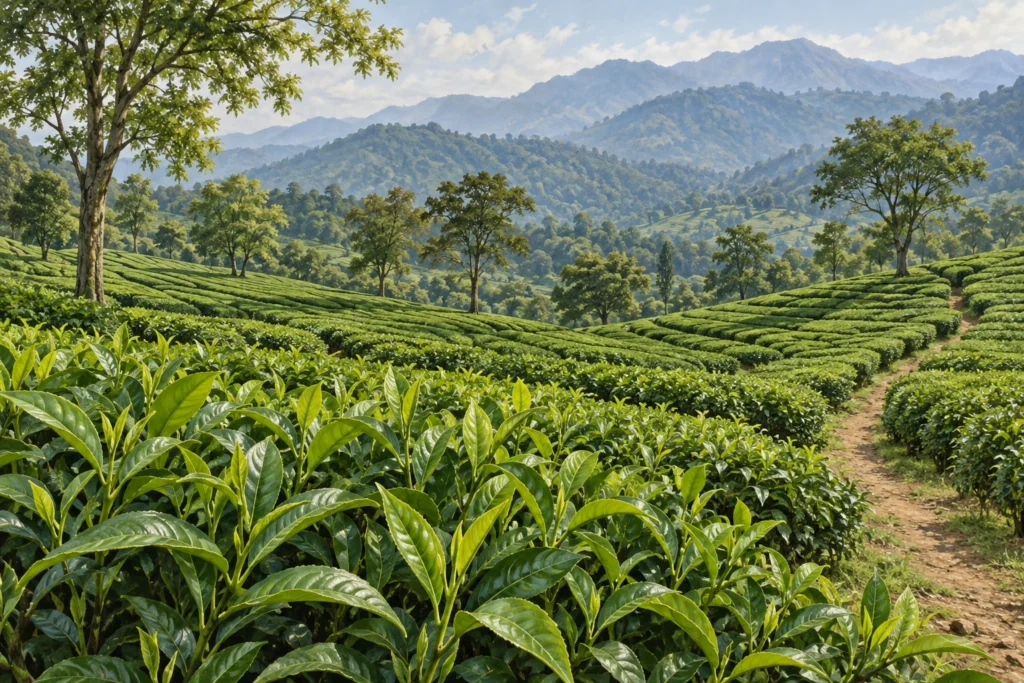
Kangra tea includes black and green tea, with cultivation in the region dating to the nineteenth century. Around Palampur, tea connects agriculture with processing, trade, employment and the district’s visitor identity. A tea garden is a working landscape, not automatically an open public attraction.
Kangra tea: cultivation, history and identity
[LINK NEEDED: kangra-tea]
Beyond a tourism-only economy
Palampur’s economic life includes agriculture, tourism and professional services. Across the district, a useful economic profile must also examine how towns provide markets, education and healthcare to surrounding settlements. Visitor spending is one part of this picture, not a complete measure of livelihoods.
District output, employment shares and crop production require dated statistical sources. This hub does not present unverified district GDP or imply that State-level figures describe Kangra.
Economy and livelihoods of Kangra
[LINK NEEDED: kangra-economy]
Agriculture and horticulture in Kangra
[LINK NEEDED: agriculture-horticulture-kangra]
Research and local enterprise
CSIR–Institute of Himalayan Bioresource Technology at Palampur works on Himalayan biological resources and technologies with societal and industrial applications. It connects the district’s natural-resource story with research, skills and enterprise.
Nature, water and environmental change
Pong reservoir and birdlife
Pong’s reservoir landscape is also a wildlife and wetland landscape. Migratory birds are a major part of its identity. Water levels affect the shoreline, so photographs taken in different seasons can show very different conditions. Wildlife viewing should respect access restrictions and avoid disturbing birds.
Pong Dam Lake and Maharana Pratap Sagar
[LINK NEEDED: pong-dam-lake]
Mountain landscapes require a different scale of planning
The Dhauladhar’s visual proximity to towns can disguise the difference between a short urban outing and a mountain journey. Conservation, trail use, waste and construction pressures belong in the same discussion as scenery. A viewpoint photograph is not evidence that a route is accessible or suitable for everyone.
Dhauladhar range: geography and landscapes
[LINK NEEDED: dhauladhar-range]
Environment and conservation in Kangra
[LINK NEEDED: kangra-environment-conservation]
Tourism and outdoor experiences
Choose a visit around an interest rather than trying to cover the entire district in one day. Forts and temples, tea landscapes, Tibetan culture, wetland birdwatching and mountain trails involve different travel patterns.
| Interest | A starting point |
|---|---|
| History and architecture | Kangra Fort, Baijnath and Masroor |
| Culture and urban exploration | Dharamshala and McLeod Ganj |
| Tea and research landscapes | Palampur |
| Paragliding | Bir–Billing; verify operator credentials and current flying conditions |
| Wetland landscapes | Pong reservoir |
| Walking and trekking | Dharamshala-area routes such as Triund and Kareri; assess current route conditions |
Bir and Billing describe different parts of the paragliding experience: Billing is associated with launching, while the Bir area includes landing and visitor facilities. Trekking routes also need their own guidance; a popular route is not automatically suitable in every season.
Tourism in Kangra
[LINK NEEDED: kangra-tourism]
Triund trek
[LINK NEEDED: triund-trek]
Kareri Lake trek
[LINK NEEDED: kareri-lake-trek]
Bir–Billing paragliding guide
[LINK NEEDED: bir-billing-paragliding]
Getting around and planning a visit
Gaggal Airport is the district’s air gateway. Pathankot is an important broad-gauge rail approach, while the Kangra Valley Railway is a separate narrow-gauge system. Do not assume that every rail section or advertised flight operates on your intended date.
For road travel, choose the actual town or village as your destination rather than “Kangra” alone. Mountain roads, local traffic and weather can make a kilometre-based estimate misleading. Keep flexible time for transfers and check current transport information before departure.
How to reach Kangra and travel within the district
[LINK NEEDED: how-to-reach-kangra]
Kangra Valley Railway
[LINK NEEDED: kangra-valley-railway]
Education, research and healthcare
Kangra’s institutional life extends beyond administration and tourism. Palampur is associated with agricultural education and Himalayan bioresource research, while Dharamshala and other towns serve as educational centres for their surrounding areas.
CSIR–IHBT is a research institution; government colleges serve a different educational role. Their presence should not be converted into claims about admissions, programme availability or public campus access without current confirmation.
Healthcare also needs a dedicated district directory. Hospital names alone do not establish the availability of emergency care, specialists or a particular procedure. A useful entry should carry a checked address, service scope and date of review.
Education and research institutions in Kangra
[LINK NEEDED: kangra-education-institutions]
Hospitals and healthcare in Kangra
[LINK NEEDED: kangra-hospitals-healthcare]
CSIR–IHBT Palampur
[LINK NEEDED: csir-ihbt-palampur]
Administration, representation and public services
Dharamshala is the district headquarters. District administration, revenue offices, development blocks, local bodies and courts have different functions. A tehsil is not the same unit as an Assembly constituency, and an elected representative is not a substitute for the office responsible for a service.
For residents, the practical starting point is the task: a certificate, land record, local civic issue, benefit application or court matter. Each needs the appropriate institution and current requirements. Avoid choosing an office simply because it is geographically nearest.
This hub introduces that structure; the supporting directories will carry current office details and dated electoral information. Names of office-holders and administrative-unit counts are not treated as permanent facts here.
Kangra administration and local bodies
[LINK NEEDED: kangra-administration]
Kangra constituencies and elected representatives
[LINK NEEDED: kangra-constituencies-representatives]
Public services and certificates in Kangra
[LINK NEEDED: kangra-public-services]
District courts in Kangra
[LINK NEEDED: kangra-district-courts]
People associated with Kangra
| Person | Connection to explore |
|---|---|
| Sansar Chand | Hill-state politics and the patronage associated with Kangra painting. |
| Baba Kanshi Ram | Poetry and participation in the freedom movement. |
| Ram Singh Pathania | Resistance to British power associated with the Nurpur region. |
| Captain Vikram Batra | Palampur association and Param Vir Chakra recognition for the 1999 Kargil War. |
| Major Sudhir Walia | Kangra association and posthumous Ashoka Chakra recognition. |
A person may be connected through birth, family, education, residence or work. A biography should state the actual connection instead of assuming all of these are the same.
Explore Kangra in depth
History and heritage
Trace rulers, monuments and the distinction between historical territories and modern boundaries.
History and heritage
[LINK NEEDED: history-of-kangra]
People and culture
Explore language, food, artistic traditions and community life.
People and culture
[LINK NEEDED: kangra-culture-heritage]
Places and local profiles
Move from the district overview into town and regional guides.
Places and local profiles
[LINK NEEDED: kangra-towns-villages]
Economy and livelihoods
Understand tea, agriculture, services and research-linked enterprise.
Economy and livelihoods
[LINK NEEDED: kangra-economy]
Tourism and experiences
Choose destinations and activities with dedicated practical guidance.
Tourism and experiences
[LINK NEEDED: kangra-tourism]
Resident information
Find the right subject guide for institutions and public services.
Resident information
[LINK NEEDED: kangra-public-services]
Frequently asked questions
What is the headquarters of Kangra district?
Dharamshala is the administrative headquarters. Kangra town is a separate place within the district.
Are Kangra, Dharamshala and McLeod Ganj the same place?
No. Kangra can mean the district or Kangra town. Dharamshala is the district headquarters, and McLeod Ganj is an area of Dharamshala.
What is the population of Kangra district?
The Census of 2011 recorded 15,10,075 people. This is a dated Census figure, not a present-day population estimate.
What is Kangra known for?
Its defining subjects include the Dhauladhar landscape, Kangra Fort, temple heritage, Kangra painting, tea, Tibetan cultural life and Pong reservoir.
Is Palampur in Kangra district?
Yes. Palampur is in Kangra district and is associated with tea, education and research.
Is Pong Lake a natural lake?
No. It is a reservoir on the Beas, also known as Maharana Pratap Sagar.
Is Kangra only a tourism destination?
No. It is a lived-in district with towns, villages, institutions, cultural traditions and diverse livelihoods.
Does this page provide current bookings or office contacts?
No. It is a district reference hub. Timetables, admissions, service requirements and contact details need separate, current verification.
Is Kangra only a tourism destination?
No. It is a lived-in district with towns, villages, institutions, cultural traditions and diverse livelihoods.
Is Kangra only a tourism destination?
No. It is a lived-in district with towns, villages, institutions, cultural traditions and diverse livelihoods.
Continue exploring Himachal Pradesh
Place Kangra in a wider context through the Himachal Pradesh Encyclopedia. Compare its places, institutions and landscapes with other district profiles as the reference collection grows.