
History of Himachal Pradesh
From early Himalayan communities to hill states, popular movements and modern statehood.
Explore the people, places and turning points that shaped Himachal Pradesh, with a clear timeline and regional context.
ON THIS PAGE
Overview · Timeline · Early history · Hill states · Mughal period · Gorkhas & Sikhs · British rule · Popular movements · Formation · Statehood · People & culture · Modern history · Historical evidence · Explore more · FAQs
A region with many histories
The history of Himachal Pradesh brings together the pasts of several Western Himalayan regions. Long before a territory named Himachal Pradesh was formed, these hills contained settlements, kingdoms, sacred centres and routes linking neighbouring valleys with the plains and the Tibetan world.
The modern administrative unit took shape on 15 April 1948 and became a full state on 25 January 1971. Its earlier history therefore concerns the territories that now form Himachal Pradesh, rather than one ancient state with today’s boundaries.
Understanding this distinction makes the larger story clearer. Kangra’s encounters with regional empires, Chamba’s court and temple traditions, Bushahr’s mountain connections and Shimla’s colonial institutions followed different paths before becoming part of a shared state.
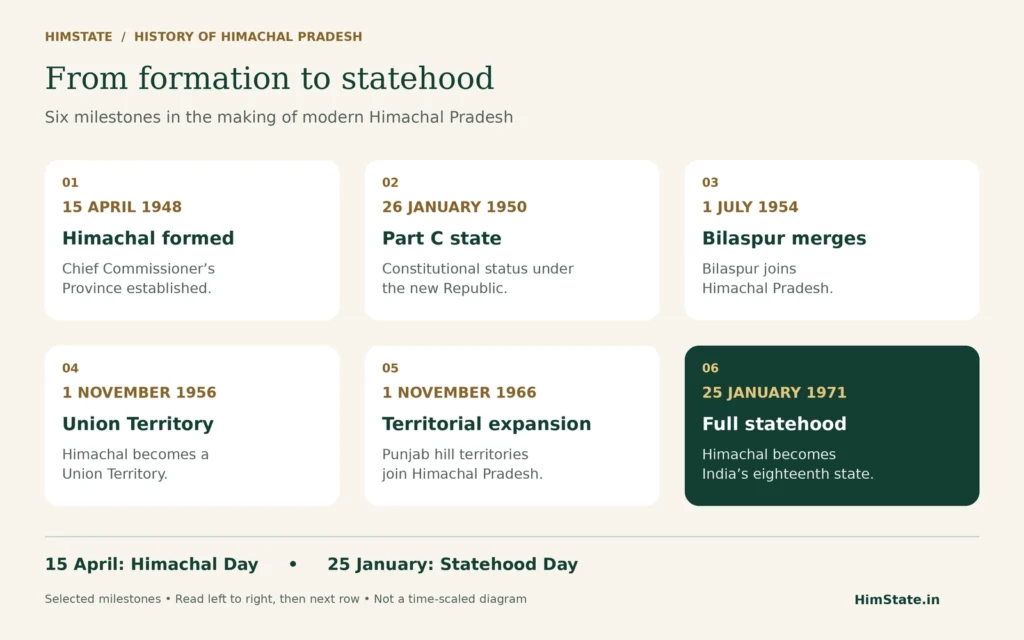
Formation: 15 April 1948
The Chief Commissioner’s Province brought together former hill states.
Expansion: 1 November 1966
Transferred Punjab hill territories substantially enlarged Himachal Pradesh.
Statehood: 25 January 1971
Himachal Pradesh became the eighteenth state of the Indian Union.
History of Himachal Pradesh: key timeline
Read the timeline as a sequence of regional and constitutional turning points. A change of ruler, a new district and the creation of a state are different kinds of event.
| Date or period | Event | Why it matters |
|---|---|---|
| Before written records | Stone Age sites in the hills | Archaeology establishes human activity before surviving dynastic accounts. |
| Early historical period | Trigarta, Kuluta and other regional names | These refer to older territories and communities, not modern districts. |
| Tenth century CE | Chamba develops as a royal centre | Sahil Varman is associated with the shift from Brahmapura, now Bharmour. |
| 996 CE | Foundation of Tabo monastery | A dated landmark in Spiti’s Buddhist history. |
| 1527 | Foundation of Mandi town | Associated with Ajbar Sen; the town’s founding differs from the ancestry of the ruling line. |
| 1620 | Mughal capture of Kangra Fort | A major change in control of a strategic hill stronghold. |
| 1809 | Kangra Fort comes under Ranjit Singh | Sikh intervention changes the balance between Sansar Chand and the Gorkhas. |
| 1815 | British victory in the western hill campaign | Gorkha control in the Shimla hill states is displaced. |
| 1846 | Kangra passes to the British | Follows the First Anglo-Sikh War. |
| 1864 | Shimla becomes summer capital of British India | Seasonal imperial administration strengthens its political importance. |
| 1903 | Kalka–Shimla railway opens | A new transport connection reshapes access to Shimla. |
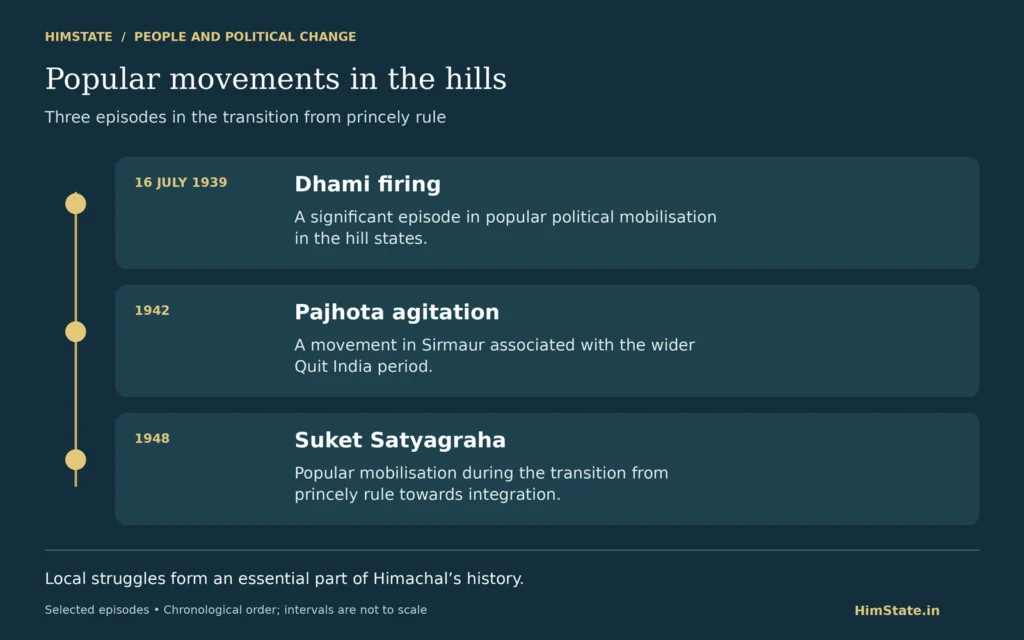
| 16 July 1939 | Dhami firing | A significant event in the hill states’ popular political movements. |
| 1942 | Pajhota agitation | A Sirmaur movement associated with the wider freedom struggle. |
| 1948 | Suket Satyagraha and integration | Popular mobilisation forms part of the transition away from princely rule. |
| 15 April 1948 | Formation of Himachal Pradesh | Chief Commissioner’s Province established. |
| 26 January 1950 | Part C state status | A constitutional category under the original Constitution. |
| 1952 | First Legislative Assembly election | Representative institutions develop before full statehood. |
| 1 July 1954 | Bilaspur merges with Himachal Pradesh | A separate post-Independence unit joins Himachal. |
| 1 November 1956 | Union Territory status | A new constitutional arrangement replaces Part C status. |
| 1 May 1960 | Kinnaur district is formed | Separated from the former Mahasu district. |
| 1 November 1966 | Punjab hill areas are transferred | Territorial expansion precedes full statehood. |
| 25 January 1971 | Full statehood | The State of Himachal Pradesh Act, 1970 takes effect for state formation. |
| 1 September 1972 | District reorganisation | Hamirpur and Una become separate districts in the reorganisation of Kangra. |
Detailed Himachal Pradesh history timeline
[LINK NEEDED: himachal-pradesh-history-timeline]
Prehistory, early communities and historical evidence
Before dynasties
Archaeological exploration has identified Stone Age sites in Kangra and Mandi. Such evidence places human activity in these landscapes before the surviving histories of named kingdoms. Tools and their archaeological contexts can reveal activity and technology; they do not by themselves identify the language, caste or political identity of their makers.
Prehistory is not the same as geological history. The formation of the Himalayas concerns the Earth’s physical past, while prehistoric archaeology studies people before written records. Nor does finding an ancient object prove that a modern settlement has been continuously occupied since its manufacture.
Ancient regional names
Trigarta is associated with the Kangra and adjoining foothill world, while Kuluta belongs to the upper Beas–Kullu context. Audumbaras and Kulindas, also called Kunindas, appear in accounts of the early western Himalayan political landscape. Their territories should not be drawn as exact copies of present district boundaries.
Literary references, inscriptions and coins provide different kinds of evidence. An epic association can show the place a region holds in cultural memory; a dated inscription can establish a narrower historical fact. Neither should be stretched into an uninterrupted ruler-by-ruler chronology without supporting material.
Connections with wider north India
Early Himalayan history belongs within wider exchanges involving the plains and neighbouring mountain regions. Accounts often discuss Mauryan, Kushan and Gupta influence. Influence, tribute, cultural contact and direct administration are not interchangeable: a claim that an empire governed every part of today’s Himachal requires evidence for the particular place and period.
Prehistory and archaeology of Himachal Pradesh
[LINK NEEDED: prehistory-archaeology-himachal-pradesh]
Ancient kingdoms and janapadas
[LINK NEEDED: ancient-kingdoms-himachal-pradesh]
Hill kingdoms and regional histories
There was no single medieval kingdom covering all of present-day Himachal Pradesh. Read the former states as connected political territories, with their own centres, rivalries and changing relationships.
Kangra and the Katoch rulers
Kangra’s political history is closely associated with the Katoch ruling house and the older name Trigarta. Its fort became a focus of conflict and negotiation between local rulers and larger powers. Traditions tracing the dynasty to the Mahabharata are part of its claimed ancestry, rather than a securely dated continuous genealogy.
Explore Kangra and the Katoch rulers
[LINK NEEDED: history-of-kangra]
Chamba and Brahmapura
Bharmour, formerly Brahmapura, preceded Chamba town as a royal centre. Sahil Varman is associated with the move to Chamba in the tenth century. Temple patronage and surviving grants help illuminate the former state; the Champavati founding story belongs to its remembered traditions.
Explore Chamba and Brahmapura
[LINK NEEDED: history-of-chamba]
Mandi and Suket
Mandi and Suket were distinct hill states before their integration into the modern district. Mandi town was founded by Ajbar Sen in 1527. Their rivalries and the contested Balh valley show how neighbouring states could share cultural connections while competing for territory.
Explore Mandi and Suket
[LINK NEEDED: history-of-mandi-and-suket]
Kullu and its royal centres
The Kullu valley has a history distinct from that of the modern district. Naggar and Sultanpur belong to its changing royal geography. Accounts of Behangamani Pal and the earliest ruling line include inherited traditions whose exact chronology needs careful treatment.
Explore Kullu and its royal centres
[LINK NEEDED: history-of-kullu]
Bushahr and Kinnaur
Before integration, Kinnaur belonged to the former Bushahr state, whose headquarters were at Rampur. This political setting helps explain why Kinnaur’s history cannot begin with its creation as a district in 1960. The Sutlej corridor also places it within a wider mountain world.
Explore Bushahr and Kinnaur
[LINK NEEDED: history-of-bushahr-and-kinnaur]
Sirmaur and Nahan
Nahan was founded by Karam Prakash in 1621 and became the capital of Sirmaur. The state’s history also includes earlier political centres and rural regions. The later Pajhota agitation makes popular mobilisation an essential part of its story.
Explore Sirmaur and Nahan
[LINK NEEDED: history-of-sirmaur]
Bilaspur and Kahlur
The former Bilaspur state is also known as Kahlur. Its princely past, separate administrative position after Independence and merger with Himachal in 1954 should be distinguished. Old Bilaspur’s relationship with the reservoir landscape introduces another chapter in its modern history.
Explore Bilaspur and Kahlur
[LINK NEEDED: history-of-bilaspur]
Lahaul and Spiti
Lahaul and Spiti have separate historical backgrounds despite their shared district name. Lahaul’s changing relationships with Kullu and Ladakh differ from Spiti’s Buddhist institutional history. Mountain routes connected these regions, but did not give them an identical political chronology.
Explore Lahaul and Spiti
[LINK NEEDED: history-of-lahaul-and-spiti]
The smaller Shimla hill states
Baghal, Bhagat, Keonthal, Dhami, Kunihar and other small states formed a varied political landscape around the area now associated with Shimla and Solan. Their histories involve local courts, Gorkha expansion, British arrangements and later popular movements.
Explore The smaller Shimla hill states
[LINK NEEDED: shimla-hill-states-history]
Una, Jaswan and Kutlehar
Present-day Una brings together places with older associations including Jaswan and Kutlehar. The creation of Una district in 1972 is a modern administrative event; it does not mark the beginning of settlement or political life in the region.
Explore Una, Jaswan and Kutlehar
[LINK NEEDED: history-of-una]
Princely states of Himachal Pradesh
[LINK NEEDED: princely-states-himachal-pradesh]
Sultanate and Mughal encounters with the hills
The hill states were connected to the politics of northern India through military campaigns, tribute, alliances and court relationships. Their experience varied: control over a fort or a ruler’s submission did not necessarily mean that every neighbouring valley came under the same form of administration.
Kangra Fort was captured by Mughal forces in 1620 during Jahangir’s reign. The fort’s position made it important beyond the immediate town. Its history provides a concrete example of how an imperial intervention could change the regional balance of power.
Mughal-era history also extends beyond warfare. Court patronage and artistic exchange belong alongside political events. Regional courts remained important settings for local authority and cultural production, even when their rulers negotiated relationships with more powerful neighbours.
Mughal relations with the Himachal hill states
[LINK NEEDED: mughal-rule-himachal-hill-states]
Kangra Fort: history and changing rulers
[LINK NEEDED: kangra-fort-history]
Gorkha expansion, Sikh power and British intervention
Expansion into the western hills
Gorkha expansion from Nepal brought Sirmaur and the Shimla hill states into a period of military pressure and changing rule. Amar Singh Thapa’s campaigns also affected the balance around Kangra. Local rulers were participants in these conflicts, forming alliances according to their own interests.
Kangra in 1809
Sansar Chand sought assistance from Maharaja Ranjit Singh against the Gorkhas. Kangra Fort came under Ranjit Singh in 1809. This was a decisive change in control of the fort; it should not be described as the Gorkhas first conquering the entire Kangra kingdom and then governing it uniformly.
Two stages in the British advance
The British campaign of 1815 ended Gorkha power in the Shimla hill region and produced new arrangements with hill chiefs. Kangra’s incorporation into British territory came later, in 1846, after the First Anglo-Sikh War. These were separate stages of expansion, affecting different areas.
Gorkha campaigns in Himachal Pradesh
[LINK NEEDED: gorkha-campaigns-himachal-pradesh]
Sikh rule and the hill states
[LINK NEEDED: sikh-rule-himachal-hill-states]
British rule, princely states and the rise of Shimla
Colonial-era Himachal was not one province with a uniform administration. Some territories were directly governed by the British, while princely states retained rulers under British paramountcy. The distinction shaped revenue collection, political authority and the routes through which people could press their demands.
The British Crown assumed authority over British Indian territories in 1858. Princely courts continued within the imperial political system. Royal cooperation with colonial power should be distinguished from the views and experiences of the people living under those rulers.
Shimla as an imperial capital
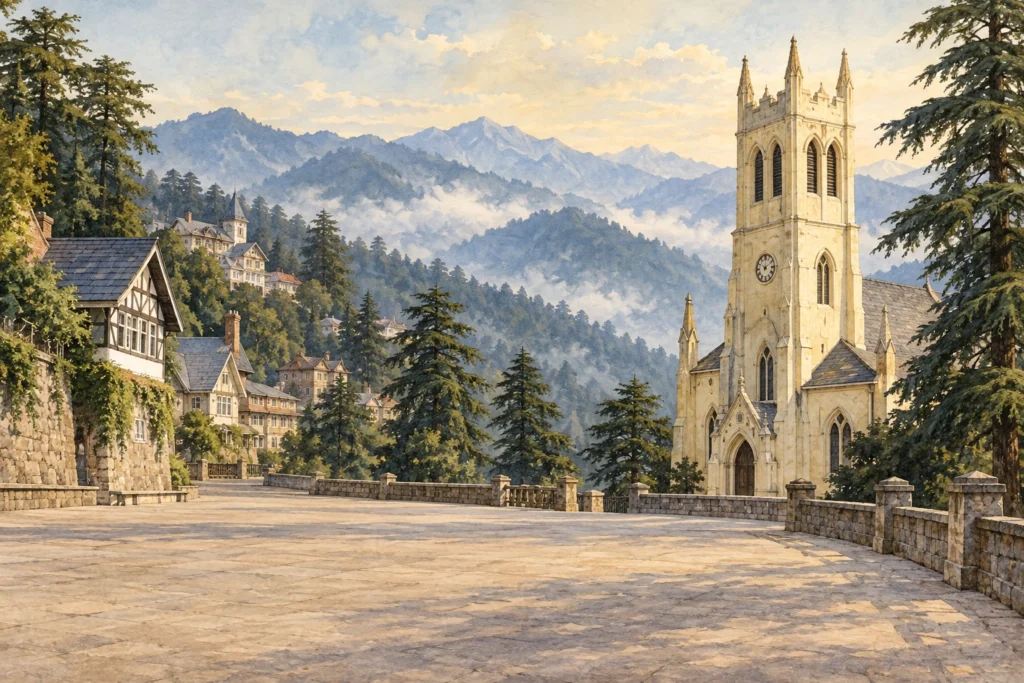
Shimla became the summer capital of British India in 1864. Its seasonal administrative role brought offices, residences and services into the hill town. The Hindustan–Tibet Road works, begun in 1850–51, and the Kalka–Shimla railway, opened in 1903, belong to the history of changing access and connections.
Work, land and everyday administration
Colonial history can also be read through land surveys, revenue settlements, transport and service work. A road or public building records more than the decision of an administrator: its history includes construction labour, maintenance and the settlements connected to it. Revenue records show how land was measured and assessed, but require interpretation alongside local evidence.
British rule in the Himachal hills
[LINK NEEDED: british-rule-himachal-pradesh]
History of Shimla
[LINK NEEDED: history-of-shimla]
Kalka–Shimla railway history
[LINK NEEDED: kalka-shimla-railway-history]
Hindustan–Tibet Road history
[LINK NEEDED: hindustan-tibet-road-history]
Resistance, freedom struggle and Praja Mandal movements
1857: differing responses
The response to the uprising of 1857 differed between hill rulers. Chamba, Bilaspur, Baghal and Dhami are recorded as assisting the British, while Bushahr adopted a hostile position. The available summary is less definite about direct support from Bushahr to the rebels. A ruler’s stance should not be used as proof of what every resident believed or did.
Revolutionary activity in Mandi
The Mandi conspiracy of 1914–15 was influenced by the Ghadar movement. Plans involving activists in Mandi and Suket were detected, and participants received prison sentences. This episode connects regional resistance with wider revolutionary networks outside the hill states.
Praja Mandals and popular rights
Praja Mandals were organisations through which people in princely states pressed for political and social change. Their struggles concerned the relationship between rulers and subjects as well as the wider end of colonial rule. This history brings public mobilisation into an account otherwise dominated by dynasties and treaties.
Dhami, 1939
The firing at Dhami on 16 July 1939 became a significant episode in popular political mobilisation in the hills. Its place in the wider movement deserves attention alongside the local sequence of events.
Pajhota, 1942
The Pajhota agitation in Sirmaur is associated with the wider Quit India period. It is an important regional example of the connection between local grievances and the freedom struggle.
Suket, 1948
Suket Satyagraha belongs to the transition from princely rule to integration. Popular participation matters here: the formation of modern Himachal cannot be explained only through decisions taken by rulers.
Baba Kanshi Ram, Padam Dev, Shivanand Ramaul, Purnanand and Yashwant Singh Parmar are among the figures associated with the region’s political transformation. Their roles differed; individual biographies should establish the organisations, places and events connected with each person.
Freedom struggle in Himachal Pradesh
[LINK NEEDED: freedom-struggle-himachal-pradesh]
Praja Mandal movements
[LINK NEEDED: praja-mandal-movements-himachal-pradesh]
Dhami firing of 1939
[LINK NEEDED: dhami-firing-1939]
Pajhota agitation of 1942
[LINK NEEDED: pajhota-agitation-1942]
Suket Satyagraha
[LINK NEEDED: suket-satyagraha-1948]
Mandi conspiracy
[LINK NEEDED: mandi-conspiracy-1914-1915]
From princely territories to Himachal Pradesh
Independence in 1947 and the formation of Himachal Pradesh in 1948 were connected but distinct events. The ending of British rule was followed by the integration of former hill states into a new administrative unit. Chamba, Mandi, Suket, Sirmaur and smaller states contributed to that formation.
The Chief Commissioner’s Province was established on 15 April 1948 through the integration of 30 former hill states. The territory was smaller than today’s Himachal Pradesh. Bilaspur joined in 1954; the major Punjab hill-area transfer followed in 1966.
A changing constitutional position
Himachal became a Part C state in 1950 and a Union Territory in 1956. These were constitutional categories, not stages of ancient regional identity. The development of elected institutions and the demand for full statehood formed a further political process.
Formation of Himachal Pradesh in 1948
[LINK NEEDED: formation-of-himachal-pradesh-1948]
Bilaspur merger with Himachal Pradesh
[LINK NEEDED: bilaspur-merger-himachal-pradesh-1954]
Constitutional development of Himachal Pradesh
[LINK NEEDED: constitutional-history-himachal-pradesh]
Territorial expansion and full statehood
The significance of 1966
The Punjab reorganisation brought Kangra and other transferred hill territories into Himachal Pradesh on 1 November 1966. This greatly changed the scale of the territory and brought regions with different administrative pasts into one unit. Territorial enlargement did not itself grant full statehood.
25 January 1971
The State of Himachal Pradesh Act, 1970 provided for the establishment of the state. Full statehood took effect on 25 January 1971. The date marks a constitutional change in status, rather than the first use of the name Himachal Pradesh or the first settlement of its territory.
The role of Yashwant Singh Parmar
Yashwant Singh Parmar was a central figure in Himachal’s political development and its first Chief Minister. His leadership belongs within the larger story of representative institutions, regional aspirations and the work of many participants in the statehood movement.
Why two annual dates matter
Himachal Day, 15 April, commemorates the 1948 formation. Statehood Day, 25 January, marks full statehood in 1971. They refer to different milestones and should not be used interchangeably.
Punjab reorganisation and Himachal Pradesh
[LINK NEEDED: punjab-reorganisation-himachal-pradesh-1966]
Himachal Pradesh statehood movement
[LINK NEEDED: himachal-pradesh-statehood-movement]
Himachal Day and Statehood Day
[LINK NEEDED: himachal-day-vs-statehood-day]
Yashwant Singh Parmar
[LINK NEEDED: yashwant-singh-parmar]
People, livelihoods and cultural history
A history of the hills also belongs to cultivators, herders, traders, artisans, labourers and households. Their experiences do not always appear as clearly as royal events in surviving accounts. Reading social history means asking who produced food, maintained routes, made objects and carried knowledge between generations.
Seasonal movement and exchange linked different elevations and valleys. The history of a mountain route is therefore more than a list of military journeys. Markets, pilgrimage and work offer other explanations for how people, goods and ideas travelled.
Women and histories beyond the court
Women’s work and participation need attention in household histories, oral testimony, craft traditions and records of public life. Court-centred accounts can obscure this work. Equally, communities should not be presented as timeless examples of one occupation, costume or social role.
Religion and institutions
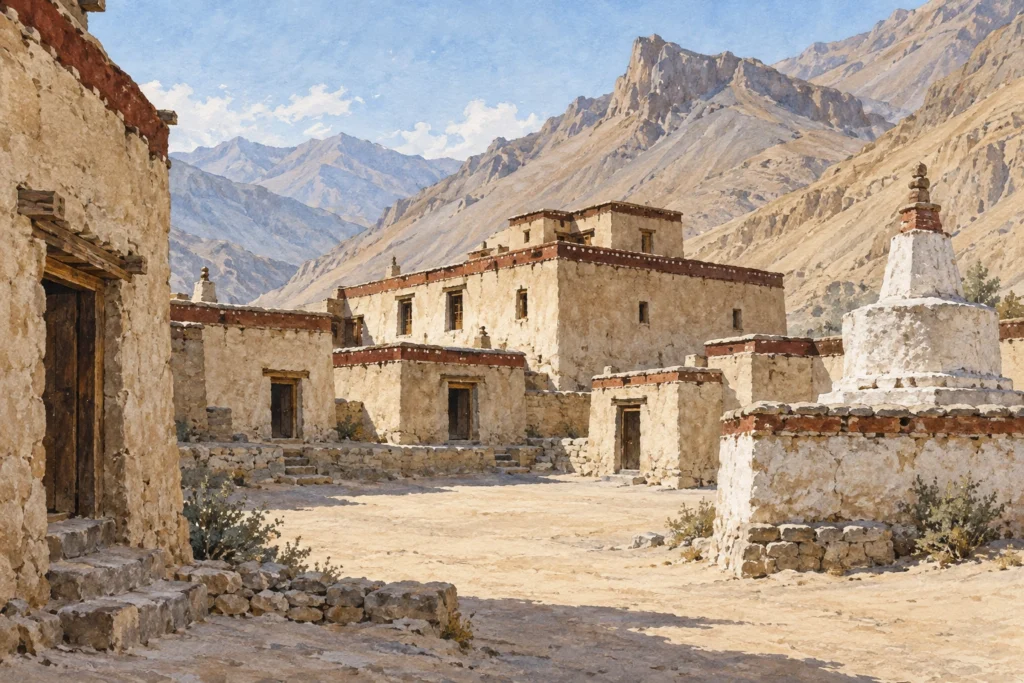
Temples, monasteries and local sacred traditions preserve histories of patronage, learning and community life. Tabo monastery, founded in 996 CE, is a major landmark in Spiti’s Buddhist history. Its murals and earthen architecture are historical evidence as well as living religious heritage. A founding date should not be assumed to date every later structure or repair.
Painting and skilled work
Pahari painting developed through several regional centres, including Guler, Kangra and Chamba. Sansar Chand’s patronage is important to the Kangra school. Artists, workshops and the circulation of styles belong beside the names of patrons. “Pahari painting” also includes centres outside modern Himachal, so its artistic geography is wider than the state boundary.
Social history of Himachal Pradesh
[LINK NEEDED: social-history-himachal-pradesh]
Women in Himachal Pradesh history
[LINK NEEDED: women-in-himachal-history]
Historic trade routes of Himachal Pradesh
[LINK NEEDED: historic-trade-routes-himachal-pradesh]
Buddhist history of Himachal Pradesh
[LINK NEEDED: buddhist-history-himachal-pradesh]
History of Pahari painting
[LINK NEEDED: pahari-painting-history]
Modern Himachal: institutions and changing landscapes
Statehood was a major milestone, but the historical story continued. District reorganisation, expanding public institutions and changes in livelihoods shaped the everyday meaning of belonging to Himachal Pradesh.
Kinnaur had already become a separate district on 1 May 1960. Hamirpur and Una became separate districts on 1 September 1972 in the reorganisation of Kangra. Such changes explain why an older record may place a present-day district within another administrative unit.
Education and public life
The State Education Department dates its establishment to 1948. Its institutional history offers one route into studying the later growth of education. The experiences of students, teachers and families add dimensions that a list of departmental milestones alone cannot capture.
Orchards, infrastructure and local change
Apple cultivation provides an example of a livelihood whose modern history involves growers, planting material, markets and experimentation. Samuel Stokes’ work at Kotgarh is one important part of that story. It should not be compressed into a claim that a single person introduced every apple grown in Himachal.
Infrastructure history also requires attention to places and people affected by change. Bilaspur’s old town and the Bhakra reservoir landscape connect development with relocation and memory. An account of a project should explain local consequences alongside its technical purpose.
Shimla and diplomacy
The Simla Agreement between India and Pakistan was signed on 2 July 1972. It belongs to the international history associated with the city. It was a separate event from Himachal’s statehood in 1971 and the district changes of 1972.
District formation history of Himachal Pradesh
[LINK NEEDED: district-formation-history-himachal-pradesh]
History of education in Himachal Pradesh
[LINK NEEDED: education-history-himachal-pradesh]
History of apple cultivation in Himachal Pradesh
[LINK NEEDED: apple-cultivation-history-himachal-pradesh]
Old Bilaspur and the Bhakra reservoir
[LINK NEEDED: old-bilaspur-bhakra-history]
Simla Agreement of 1972
[LINK NEEDED: simla-agreement-1972]
How to read Himachal’s historical evidence
Archaeology and inscriptions
Tools, built remains, inscriptions and grants help establish particular activities, places and dates. Their context and interpretation matter as much as the object itself.
Written records
Court accounts, administrative papers and gazetteers preserve valuable information. They also reflect the purpose and viewpoint of their authors.
Oral tradition and memory
Songs, family narratives and founding stories reveal how communities remember the past. They should be identified as traditions when independent verification is unavailable.
A building can have several historical layers: an early foundation, later additions, repairs and modern conservation. Similarly, an ancient place-name can outlast the boundaries of the polity once associated with it. Precise questions produce better history than an unsupported claim that something is simply “the oldest”.
Sources for studying Himachal Pradesh history
[LINK NEEDED: sources-himachal-pradesh-history]
Museums and historical collections
[LINK NEEDED: museums-himachal-pradesh]
Explore history in greater depth
Choose a period or theme to continue beyond the overview. Regional histories above provide a second route into the subject.
Ancient history
Archaeology, early regional names and the limits of surviving evidence.
Explore Ancient history
[LINK NEEDED: ancient-history-himachal-pradesh]
Medieval history
Hill states, political relationships and the development of regional centres.
Explore Medieval history
[LINK NEEDED: medieval-history-himachal-pradesh]
Colonial history
Direct British rule, princely administrations, transport and social change.
Explore Colonial history
[LINK NEEDED: british-rule-himachal-pradesh]
Freedom and popular movements
Regional resistance, Praja Mandals and participation in political change.
Explore Freedom and popular movements
[LINK NEEDED: freedom-struggle-himachal-pradesh]
Formation and statehood
Integration, constitutional status, territorial expansion and statehood.
Explore Formation and statehood
[LINK NEEDED: himachal-pradesh-statehood-movement]
Historical people
Biographies that connect individuals with documented places, institutions and events.
Explore Historical people
[LINK NEEDED: historical-personalities-himachal-pradesh]
Frequently asked questions
When was Himachal Pradesh formed?
The modern administrative unit was formed on 15 April 1948. Full statehood came later, on 25 January 1971.
Was Himachal Pradesh one kingdom in ancient times?
No. The territory now within the state includes several older regions and political histories. Modern state boundaries should not be projected backwards onto ancient kingdoms.
What is the difference between Himachal Day and Statehood Day?
Himachal Day on 15 April marks formation in 1948. Statehood Day on 25 January marks the attainment of full statehood in 1971.
Was all of Himachal Pradesh part of Punjab?
No. Some territories had been administered within Punjab, while others were princely states or part of the separate Himachal administrative unit. The 1966 transfer brought Punjab hill territories into Himachal Pradesh.
When did Bilaspur join Himachal Pradesh?
Bilaspur merged with Himachal Pradesh on 1 July 1954. It was not part of the initial 1948 formation.
Who was the first Chief Minister of Himachal Pradesh?
Yashwant Singh Parmar was the first Chief Minister. His role is central to the history of the state’s political development.
What were the Praja Mandal movements?
They were popular movements in princely states seeking political and social change. They form an essential part of the transition from princely authority towards representative public institutions.
Can local legends be treated as historical facts?
Legends are valuable evidence of belief and memory. Specific events, dates and genealogies require separate corroboration before being presented as established historical facts.
Connect the history with today’s Himachal
Continue with the geography that shaped regional connections, the cultural traditions that carry historical memory, or the institutions through which the state is governed today.