
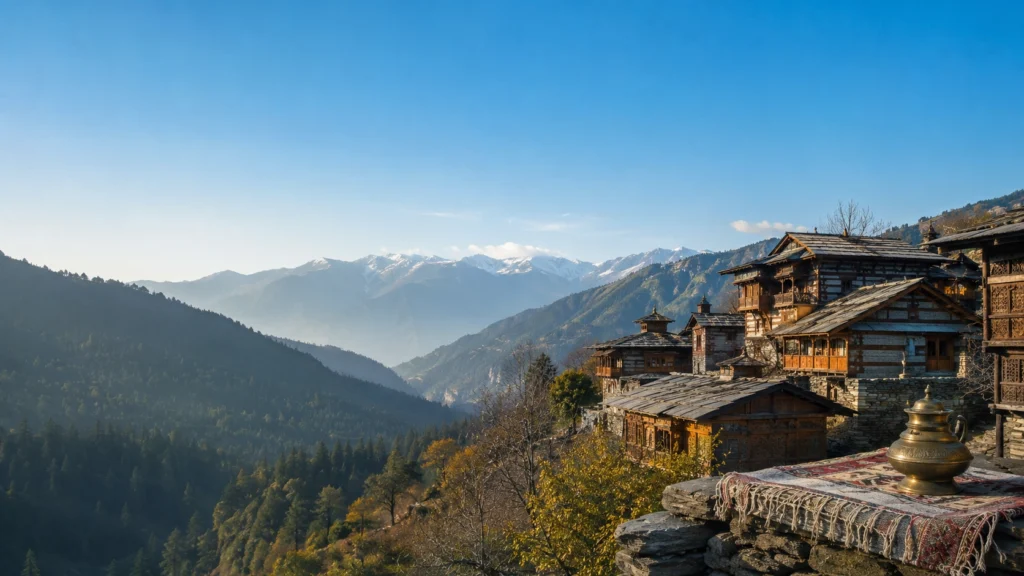
Living traditions · Material heritage · Regional identity
Culture and Heritage of Himachal Pradesh
Explore the customs, creative traditions, sacred landscapes, architecture, languages and everyday practices through which communities across Himachal Pradesh express identity and memory.
Last reviewed: 2 September 2026 • State-level overview • Official and institutional sources
Tangible heritage
Buildings, objects and collections
Living heritage
Skills, rituals and oral traditions
Regional identities
District, valley and community contexts
Verified resources
Museums, ASI, GI and UNESCO
Overview · Snapshot · Regional diversity · Explore · Living heritage · Resources · FAQs
A connected field of memory and practice
Understanding Himachal Pradesh’s Cultural Heritage
The culture of Himachal Pradesh has developed across river valleys, lower hill regions, forested middle ranges and high-altitude districts.
Terrain, climate, older political centres, trade routes, pilgrimage networks and contact with neighbouring regions have influenced local forms of architecture, worship, language, clothing, food and artistic expression.
Cultural heritage includes more than old buildings and museum objects. It also includes skills, songs, stories, rituals, fairs, community institutions, food practices and knowledge transmitted between generations.
This hub provides a State-level starting point and connects readers to detailed cultural subjects, district profiles and official resources.
Quick Facts
- Diverse district and valley traditions
- Four prominent GI-recognised cultural products
- One UNESCO-listed mountain railway
- Major State and regional museums
- Strong living traditions of crafts, fairs and sacred practices
A useful orientation
Cultural Heritage at a Glance
These reference points explain the breadth of the subject; they are not a ranking of traditions.
Material heritage
Temples, monasteries, forts, settlements, railway structures, paintings, textiles, jewellery, tools and museum collections form part of the material record.
Living heritage
Oral traditions, music, dance, rituals, fairs, craft knowledge, foodways and community participation continue through practice.
Recognised craft identities
The GI Registry includes Kullu Shawl, Chamba Rumal, Kinnauri Shawl and Kangra Paintings among Himachal-associated entries.
World Heritage railway
The operational Kalka–Shimla Railway forms part of UNESCO’s serial property, Mountain Railways of India.
Read recognition carefully: A GI protects a geographical indication; UNESCO World Heritage status applies to a defined property. Neither should be used as a general badge for unrelated products or places.
Culture changes with place and community
Culture Across Landscapes and Regions
Himachal Pradesh’s cultural geography does not follow a single visual template. Lower hill areas, central valleys and high Himalayan regions developed different combinations of settlement, agriculture, pastoral movement, worship, language, clothing and artistic practice.
District borders help navigation but do not perfectly contain culture. Languages, deity traditions, craft techniques and building forms may cross administrative boundaries, while neighbouring valleys within one district can differ from each other.
Heritage is inherited and continually remade
“Traditional” does not mean frozen. Materials change, roads alter access, practitioners adapt designs and communities debate how customs should continue. Good documentation records both continuity and change without treating living people as museum exhibits.
Objects and practices are connected
A carved building, embroidered textile or musical instrument is a material object, but its meaning depends on skills, stories, ritual use and community memory. A festival or oral tradition likewise depends on physical spaces, objects, routes and participants.
HimState cultural directory
Explore Culture and Heritage
These are planned destinations. Cards remain unlinked until their pages exist.
01 · Planned child hub
Fairs and Festivals
Seasonal gatherings, deity processions, trade fairs, agricultural cycles, religious observances and civic festivals.
02 · Planned child hub
Folk Music and Dance
Regional performance traditions, instruments, song forms and the contexts in which communities perform them.
03 · Planned child hub
Arts and Handicrafts
Painting, embroidery, weaving, wood carving, metalwork, jewellery, practitioners and geographical indications.
04 · Planned child hub
Traditional Architecture
Materials, structural systems, settlement forms, temple architecture and locally adapted building knowledge.
05 · Planned child hub
Heritage Sites and Monuments
Protected monuments, forts, palaces, historic settlements, colonial structures and transport heritage.
06 · Planned child hub
Temples and Sacred Traditions
Temple networks, monasteries, pilgrimages, sacred landscapes, local-deity institutions and protocols.
07 · Planned child hub
Languages and Oral Traditions
Regional speech, literature, folk narratives, proverbs, songs, storytelling and documentation challenges.
08 · Planned child hub
Traditional Dress and Jewellery
Regionally specific clothing, headgear, woven textiles, ornaments, ceremony and everyday use.
09 · Planned child hub
Himachali Cuisine
Everyday food, ceremonial meals, preservation, grains, pulses, dairy, seasonal ingredients and variation.
10 · Planned child hub
Communities and Traditional Lifestyles
Agricultural, pastoral, artisan and high-altitude lifeways documented without stereotyping.
11 · Planned directory
Museums and Cultural Institutions
Museums, archives, cultural departments, collections, research facilities and verified visitor links.
12 · Planned directory
Cultural Heritage by District
District profiles covering festivals, arts, architecture, food, language, sacred traditions and museums.
Important interpretive themes
How Cultural Heritage Continues
The most useful heritage coverage connects objects, places, skills and the communities that give them meaning.
Participation and community life
Fairs, rituals, music and dance can organise community relationships, religious obligations, seasonal work, exchange and shared memory. A staged performance is not always equivalent to community practice.
Skills carried through materials
Painting, embroidery, weaving, carving and metalwork preserve knowledge through technique. Museum objects document older examples; living practitioners continue and adapt the skills.
Buildings as social records
Historic buildings reveal responses to slope, climate, stone, timber, defence, worship and social organisation. Labels and restoration claims require site-specific verification.
Everyday culture
Language, food and dress vary across valleys and contexts. Ceremonial forms should not be presented as the everyday practice of the entire State.
Preservation and transmission
Conservation depends on practitioners, language communities, ritual knowledge, materials and opportunities to teach—not only on preserving buildings and objects.
Responsible documentation
Record source, date, scope, consent and uncertainty. Do not expose restricted rituals or present AI-generated people, objects and sites as documentary evidence.
Primary research gateways
Museums and Official Resources
Use institutional catalogues for objects and collections, and responsible authorities for protection or legal recognition.
Language, Art and Culture
State departmental programmes and institutional information.
Himachal State Museum
Archaeology, anthropology, Pahari painting, sculpture, jewellery and wood carving.
Bhuri Singh Museum
Pahari painting, manuscripts, bronzes, wood carving, textiles and Chamba Rumal.
GI Public Search
Official geographical-indication application and registration records.
Archaeological Survey of India
Responsible source for centrally protected monuments and ASI conservation information.
Mountain Railways of India
UNESCO record for the serial property that includes the Kalka–Shimla Railway.
Dynamic content section
Latest and Related Cultural Entries
Add a Gutenberg Query Loop here after the Culture and Heritage post category is populated. Filter by category, district, content type and cultural theme; sort recently updated entries first.
Detailed cultural entries are being added. Use the directory above to explore planned subjects and official resources.
Quick answers
Frequently Asked Questions
What is Himachal Pradesh’s culture known for?
It is known for regionally varied fairs, sacred traditions, folk performance, Pahari art, weaving, embroidery, architecture, food practices, languages and community institutions. No single custom represents the whole State.
Is there one common Himachali culture?
There are shared influences, but culture differs by district, valley, altitude, language, community and historical region. It is better understood as connected local traditions.
What is the difference between tangible and intangible heritage?
Tangible heritage includes physical places and objects. Intangible heritage includes skills, oral traditions, music, dance, rituals and knowledge carried through practice.
Which traditional crafts have geographical indications?
The GI search includes Himachal-associated entries such as Kullu Shawl, Chamba Rumal, Kinnauri Shawl and Kangra Paintings. Consult the registry for the current legal record.
Does Himachal Pradesh have a UNESCO cultural property?
The Kalka–Shimla Railway is part of UNESCO’s serial World Heritage property, Mountain Railways of India, which also includes railways in other Indian states.
Where can I see cultural collections?
Institutional starting points include Himachal State Museum in Shimla, Bhuri Singh Museum in Chamba and Kangra Art Museum. Verify current visitor information on official portals.
Can AI images document Himachali culture?
They may be used as clearly labelled editorial illustrations, but not as evidence of a real monument, costume, ritual, community or historical object.
Continue Exploring Himachal Pradesh
Culture connects people, landscapes, memory and creative practice. Continue to the Encyclopedia, a priority cultural theme or a district portal as those destinations are published.
Parent and child links are intentionally withheld until their HimState URLs are verified.
Primary references: Department of Language, Art and Culture · Himachal State Museum · Bhuri Singh Museum · Intellectual Property India · Archaeological Survey of India · UNESCO World Heritage Centre